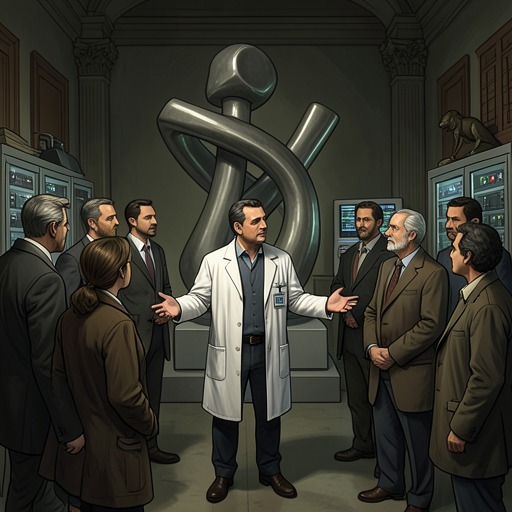
Mankind will curse the names of Los Alamos and Hiroshima
American Prometheus“Mankind will curse the names of Los Alamos and Hiroshima” is J. Robert Oppenheimer’s warning that the legacy of the atomic bomb would depend on what governments did with it after the war. Spoken as he left Los Alamos in October 1945, it turned a farewell into a public reckoning: scientific achievement, he argued, could become a source of lasting condemnation if atomic weapons entered the arsenals of nations preparing for war. The warning’s force lies in its conditional form—and in the policies Oppenheimer later pursued, which tried to keep that feared future from becoming ordinary military practice.
A warning at Los Alamos
On October 16, 1945, Oppenheimer formally resigned as director of Los Alamos. At a ceremony attended by thousands from the mesa, he accepted a Certificate of Appreciation and spoke without prepared remarks. He hoped those involved in the laboratory’s work would be able to look back with pride, but insisted that pride had to be tempered by concern. If atomic bombs became new weapons in the arsenals of a warring world, or of nations preparing for war, humanity would one day curse Los Alamos and Hiroshima.
The sentence did not reject the achievement or erase the circumstances of the work. Instead, it placed the achievement under a future test: whether the bomb would be incorporated into recurring military preparations. Oppenheimer widened that warning into an appeal for political action, saying that peoples must unite or perish and that the common peril required a world joined by law and humanity. The speech made him legible both as the laboratory’s celebrated leader and as a scientist warning against the consequences of what it had built.
From the bomb to the Super
In 1949, after the Soviet success had sharpened the nuclear arms race, Oppenheimer brought the same concern into the General Advisory Committee of the Atomic Energy Commission’s debate over a thermonuclear bomb. His objection was not only that such a weapon might kill immense numbers of people. A Hiroshima bomb yielded 15,000 tons of TNT; a feasible thermonuclear weapon might yield 100 million tons and destroy 150 to 1,000 square miles or more. The committee’s report warned that a super bomb could become a weapon of genocide, and that possessing one could damage American security by persuading the world that the United States contemplated an act of Armageddon.
Oppenheimer and the committee majority argued that the weapon should never be produced and that refusing to build it might reopen arms-control negotiations with the Soviet Union. They also addressed the possibility that the Soviets might develop one first: an American undertaking would not deter that outcome, and the existing stock of atomic bombs could deliver reprisals of comparable effectiveness. The argument thus distinguished deterrence from simply matching an opponent’s most destructive weapon. Oppenheimer favored expanding fissionable-material production for smaller tactical atomic weapons, alongside conventional forces in Western Europe, as a more economical and credible defense. This proposal anticipated a nuclear arsenal justified by specific military tasks rather than by an unbounded race of accumulation.
The problem of making nuclear weapons usable
That preference carried a tension. In the 1945 farewell, Oppenheimer had warned that adding atomic weapons to national arsenals could bring condemnation; by 1951, he was supporting battlefield weapons as alternatives to city-destroying thermonuclear bombs. In Project Vista, he described tactical weapons as adjuncts to a military campaign directed toward victory, rather than weapons primarily intended to produce terror. The distinction was meant to resist plans for the mass destruction of cities, but it also made nuclear weapons easier to imagine as instruments of combat.
Oppenheimer’s argument for battlefield use therefore did not simply resolve the danger voiced at Los Alamos. It shifted the point of danger: smaller weapons might make a strategy seem more limited and militarily rational, while their use could trigger an exchange of increasingly powerful weapons. The book presents this as an unintended consequence of his effort to prevent the Air Force from treating the destruction of cities as a rational war plan. His 1946 description of atomic weapons as a supreme expression of total war stood in uneasy contrast to the later effort to define tactical weapons as limited aids to combat forces.
Secrecy and the return of the warning
In later public remarks, Oppenheimer argued that citizens and officials could not judge nuclear policy without access to the facts. He said those facts were classified and that he could not disclose them, yet described the anxiety produced when responsible groups were allowed to confront the situation candidly. He cautioned that being ahead of the Soviet Union in the number of bombs offered little strategic comfort: even a stockpile of twenty thousand would not, in a deep strategic sense, offset a Soviet stockpile of two thousand.
He also described the American plan as a massive, initial, unremitting strategic assault and criticized the ignorance surrounding the number and intended use of the weapons. In his account, secrecy fostered rumor and left even Europeans unaware of what the weapons were, how many there would be, or what they would do. The 1945 warning had imagined a future in which the bomb’s place in national arsenals would bring condemnation. His later arguments traced a path toward that danger through thermonuclear scale, battlefield use, plans for a vast first strike, and public exclusion from decisions made in secrecy. The phrase therefore functions as more than a farewell: it names the moral consequence that Oppenheimer repeatedly tried, with shifting and sometimes contradictory proposals, to avert.